01
Rendering abstraction
A hand-built RHI keeps high-level rendering independent from the backend, with concrete Vulkan and OpenGL implementations.
Pipelines · buffers · textures · swapchains
Biovoid is a ground-up engine project connecting low-level graphics, runtime architecture, and a practical editor into one coherent system.
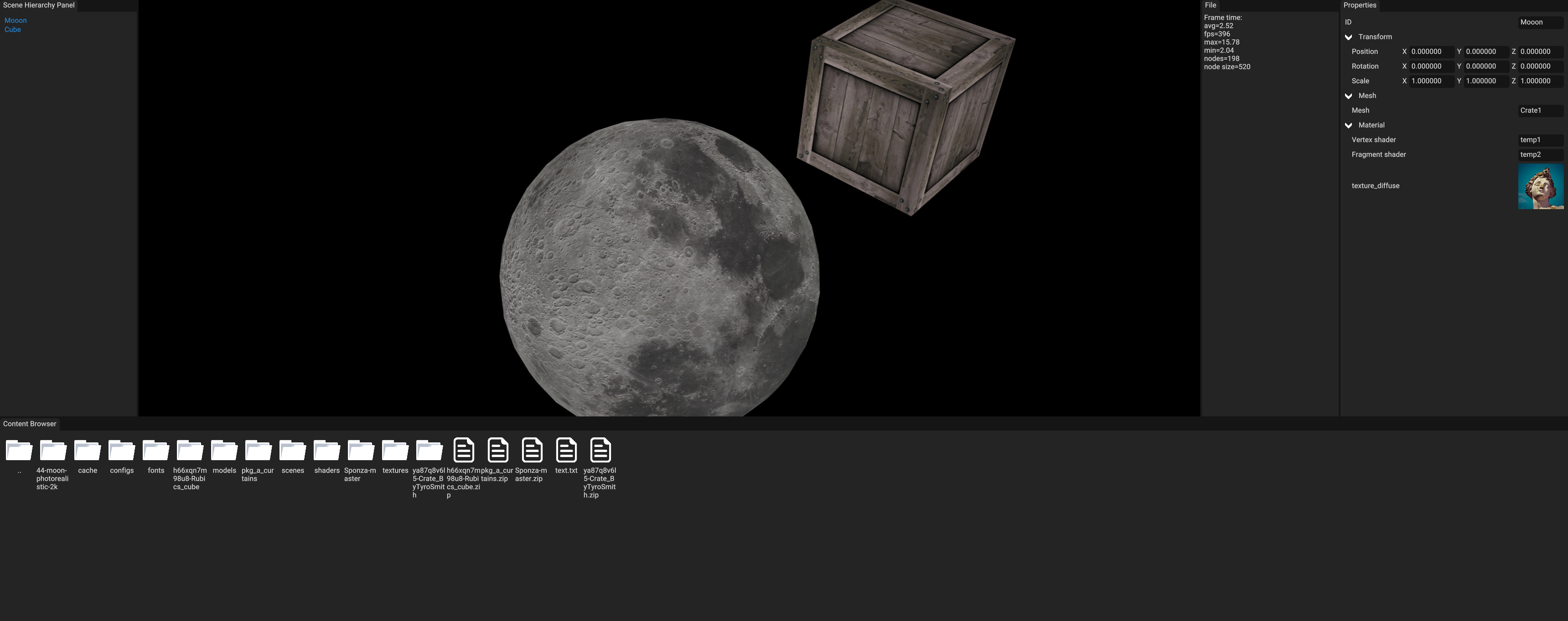
Authentic running build — captured from the project.
The work spans the boundaries recruiters care about: graphics APIs, engine architecture, developer tools, data flow, and the discipline to make them operate together.
A hand-built RHI keeps high-level rendering independent from the backend, with concrete Vulkan and OpenGL implementations.
Scene and UI passes declare targets, depth, MSAA, and callbacks before the graph drives execution in a predictable order.
The engine ships with its own scene hierarchy, inspector, content browser, docked layout, editor camera, and live frame data.
Scenes are composed through an EnTT-based ECS and serialized with FlatBuffers for a data-oriented runtime workflow.
A custom component layer handles layout, styling, scrolling, tabs, file views, events, and textured UI rendering.
Meshes, materials, textures, and shaders move from source assets into GPU-ready resources through dedicated engine systems.
Each layer has a clear responsibility. Platform events become runtime state, scene data becomes render work, and the RHI translates that work to the selected graphics API.
The render graph keeps frame construction readable while the backend owns synchronization, memory, command buffers, pipelines, and targets. That separation makes experimentation possible without hiding the hardware.
// Build the scene pass
auto& scenePass = renderGraph.addPass("scene");

scenePass.setCallback([scene] {
  scene->updateAllPrimitiveSceneInfos();
  scene->render();
});

scenePass.setMsaa(msaaSamples);
scenePass.setOutput("scene-raw", target);
scenePass.setDepthStencil();“I built Biovoid to understand—and own—the entire path from scene data to pixels.”
This project is evidence of how I approach hard technical work: trace the system end to end, design strong boundaries, work close to the platform, and build the tools that make the result usable.
I’m looking for engine, rendering, or systems work where depth matters and where I can contribute across layers—not just inside one isolated box.
Engine programming · Rendering · Systems